Shure SM58 vs sE V7 for Solo Live Gigging | Sound Clarity

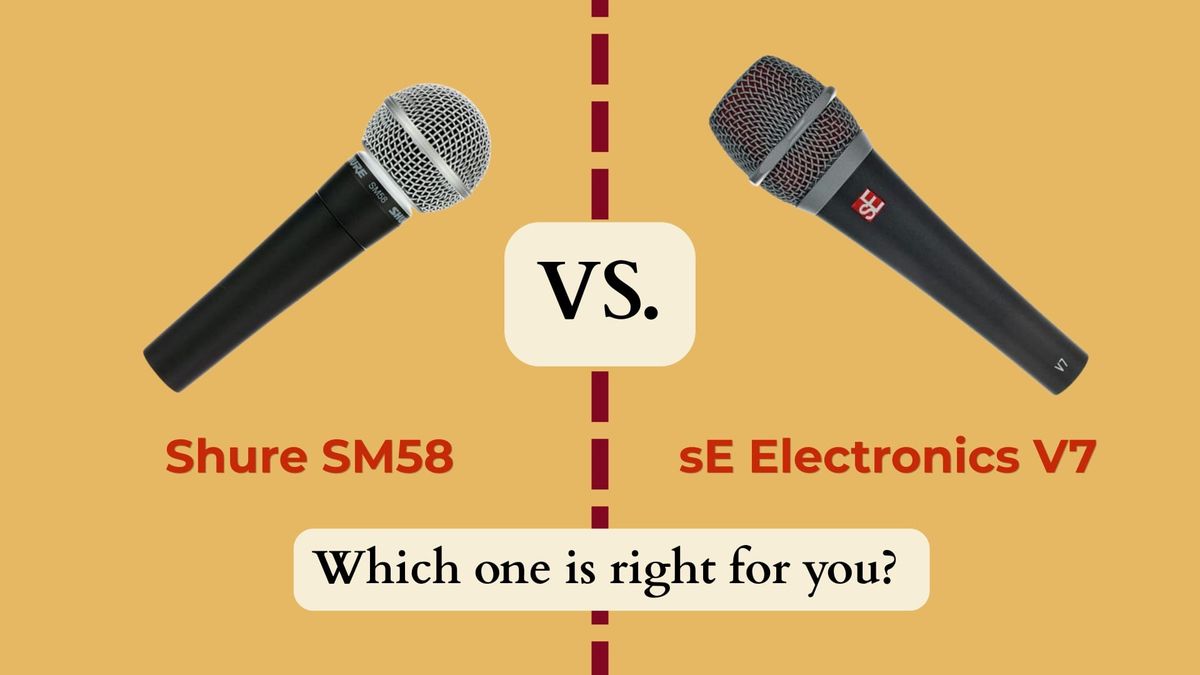
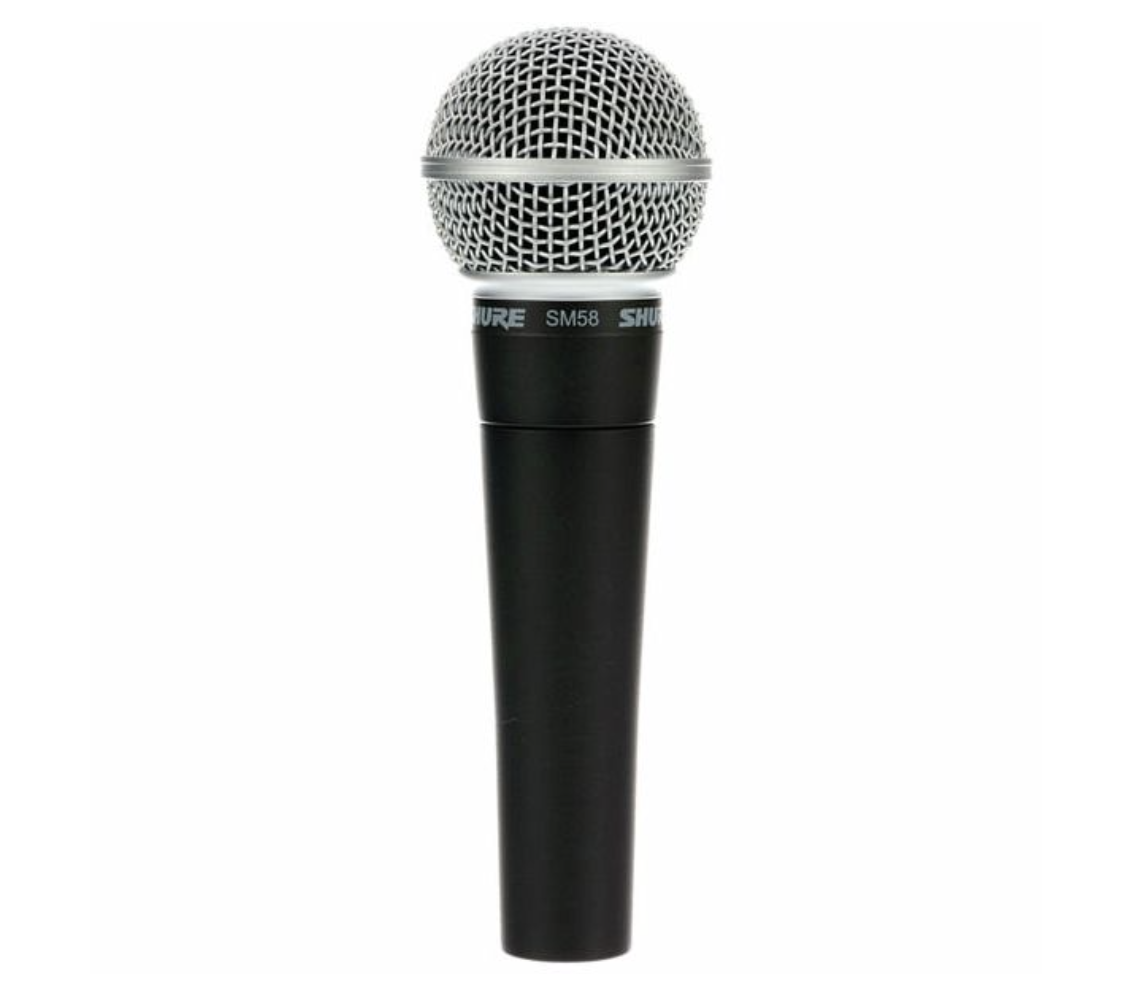
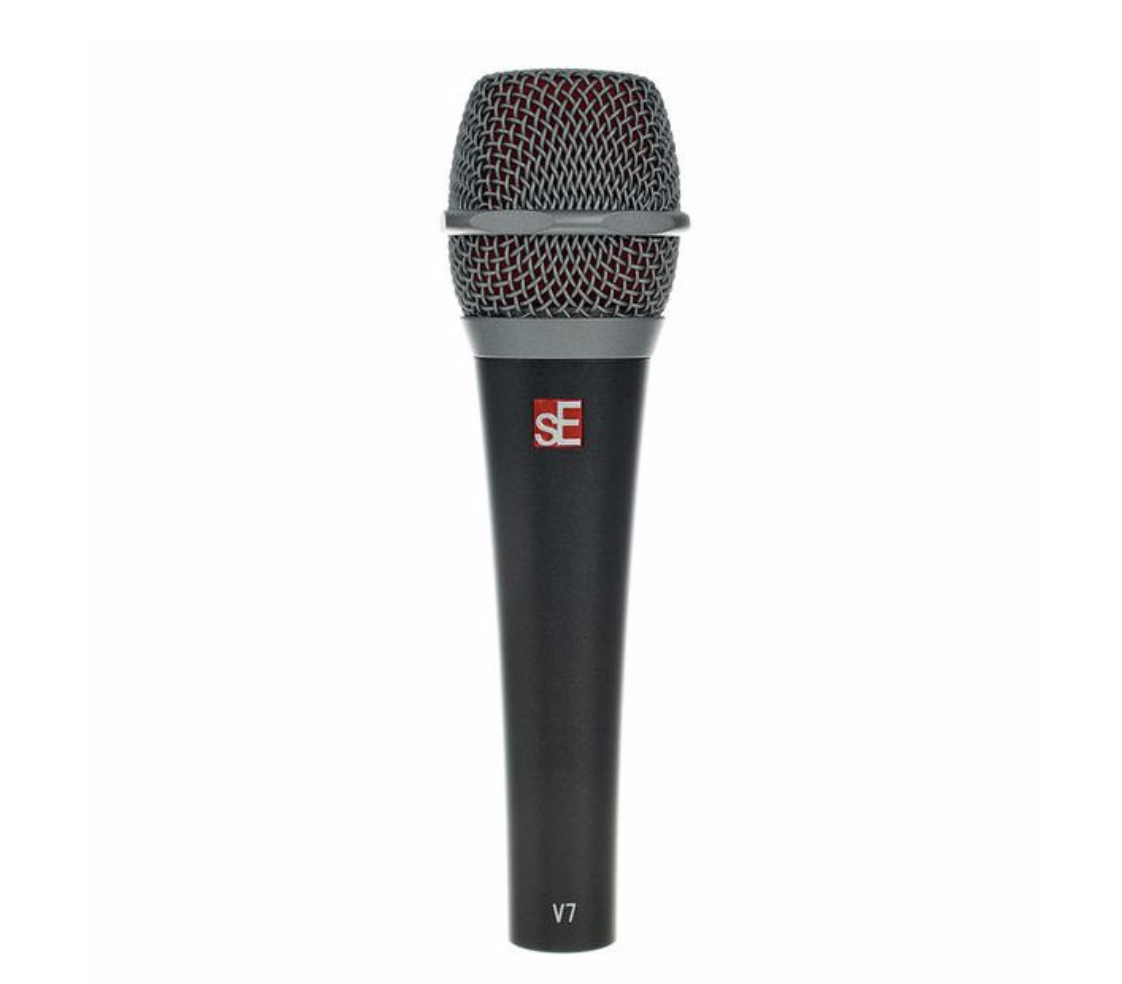
For over 50 years, the Shure SM58 has been the undisputed king of live music. It's the mic you'll find in every dive bar, arena, and rehearsal studio on the planet. But over the last few years, the sE Electronics V7 has emerged as the modern challenger, taking over pedalboards and gig bags worldwide at the exact same $99 price point.
If you’re a working musician like me, trying to decide which one deserves a permanent spot in your setup can be difficult, that's why I put together this technical breakdown, along with a few anecdotes.
I used to main an SM58 for much of my music career, but I didn't enjoy the sound that I heard out of PAs all over, so I always assumed it was my singing. It was only when I heard my voice through the sE V7 that I understood that there isn't one mic that suits everyone, quite the opposite, and today we're going to talk about why my voice doesn't gel with the SM58, and why yours might.

Technical Comparison Matrix
| Feature | Shure SM58 | sE Electronics V7 |
| Capsule Type | Dynamic | Dynamic |
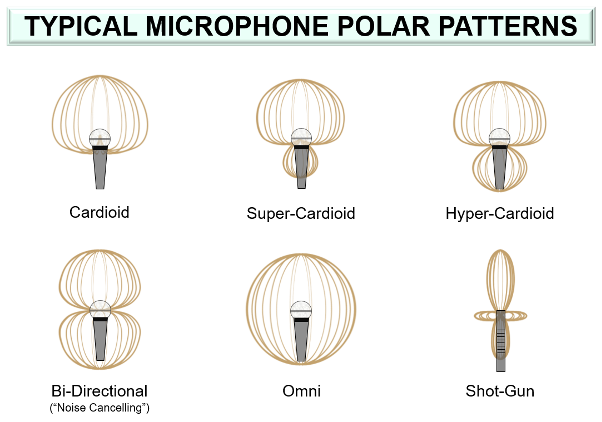
| Polar Pattern | Cardioid | Supercardioid |
| Voice Coil Material | Copper | Aluminum |
| Frequency Response | 50 Hz – 15 kHz | 40 Hz – 19 kHz |
| Impedance | 300 Ohms | 300 Ohms |
| Sensitivity | -54.5 dBV/Pa (1.85 mV) | -54 dBV/Pa (2.0 mV) |
| Off-Axis Null Point | 180° (Directly behind) | 120° (Rear-sides) |
| Grille Feature | Round mesh (Rolls on flat surfaces) | Bevelled edge (Anti-roll) |
| Street Price | ~$99 | ~$99 |
1. Polar Patterns & Monitor Placement: Cardioid vs. Supercardioid
The biggest technical difference between these two microphones isn't just how they sound—it's how they pick up sound on stage.
- Shure SM58 (Cardioid): Rejects sound best at 180° (directly behind the capsule). This means if your monitor wedge sits on the floor pointing directly at the back of the microphone, you get maximum gain-before-feedback.
- sE V7 (Supercardioid): Has a tighter front pickup pattern that rejects stage noise from the sides, but its maximum rejection occurs at 120° off-axis. It has a slight "rear lobe" that picks up sound directly at 180°.
The Real-World Impact on Stage
If you place a floor monitor directly behind an sE V7, it might feedback faster than an SM58. However, if you place two monitor wedges angled slightly to the left and right (at 120°), or if you run In-Ear Monitors (IEMs), the sE V7 will eliminate cymbal bleed, loud guitar amps, and room noise significantly better than the SM58.
I made the switch between the SM58 and sE V7 back in Portugal, when my band Adam Khan & The Coyotes was going strong. We played hard, and I used to struggle a lot with feedback, I couldn't hear myself because of the SM58's frequency response, which we'll talk about more below. This meant that I had to turn up the gain thus exposing the mic's ultimate weakness: a very low gain before feedback level.
That being said, for solo performances, and especially, more intimate performances in tighter, quieter spaces, the SM58 delivers a warmer tone that's hard to beat. This would be one of the only situations I'd take a 58 over the V7, but personally I don't find myself gigging in those scenarios too often.

2. Frequency Response & Top-End Clarity
The way these two mics shape your voice out-of-the-box requires completely different EQ strategies at the soundboard or effects processor.
Shure SM58: The Warm Mid-Range Standard
The SM58 has a pronounced presence peak around 2 kHz to 4 kHz, followed by a steep roll-off after 15 kHz. It also has a hump in between 200 Hz to 400 Hz.
- The Good: It delivers a thick, warm proximity effect and a sturdy mid-range that sound engineers have known how to mix for decades.
- The Bad: On flat PAs or budget active speakers, it can sound muddy or dark, requiring you to scoop the low-mids (~250 Hz) and boost the top-end air, this can expose you to feedback.
- Best For: Female singers. The support in the low-mids adds "meat" to the sound and the steep roll-off after 15 kHz ensures that the natural brightness of a female singer won't overload the soundboard, balancing the sound out nicely.
- Avoid If: You're a male, baritone or bass singer. The low-mid hump will muddy the sound and make your sentences harder to understand. The steep roll-off after 15 kHz removes the brightness baritone and bass singers need to make their voices cut through a busy mix.

sE V7: Modern "Mix-Ready" Air
The sE V7 uses a custom aluminum voice coil instead of traditional copper. This lighter material gives the capsule a faster transient response and extends its frequency range all the way up to 19 kHz.
- The Good: It adds a high-end clarity and "condenser-like" detail without needing extra EQ. Vocals sit on top of a dense instrument track with minimal effort.
- The Bad: If a singer has a naturally sibilant voice (harsh "S" or "T" sounds), the V7 can feel overly bright on low-quality horn drivers.
- Best For: Male singers, especially baritone and bass. The wider frequency response (40 Hz to 19 kHz) and flatter profile means that the brightness deeper voices need to cut through the mix are available for the sound engineer to tweak.
- Avoid if: You're a female singer in the mezzosoprano or soprano range. The added brightness will accentuate the part of your voice that is already naturally strong, and will likely sound shrill. The flatter EQ means you don't get as big of a help in the low-mid range to thicken your voice slightly.

To be honest, both microphones are reliable and will work well for everyone, we're being nit-picky here, but how we hear our voices, how much we like it through the PA is a massive factor in the way we present ourselves on stage, so it's worth finding not just what's good for us, but what's best.
That being said, I highly recommend EQ'ing and adding vocal effects yourself, like I do with my Hotone Ampero II Stage. Having full control of the sound of your voice will take your singing confidence through the roof. Read my review on that unit below.
 Adam Khan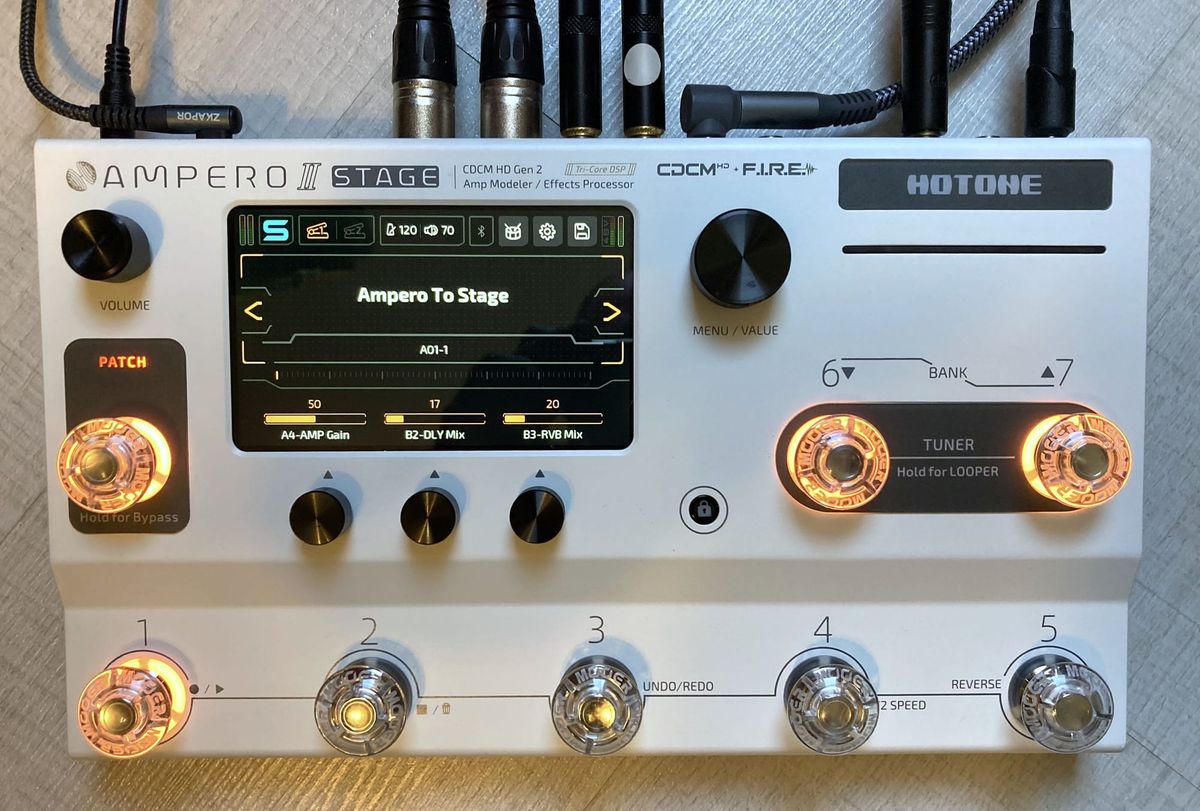
3. Build Quality, Handling Noise, and Road Usability
Both microphones are built like brick houses, but they approach small practical details differently.
Handling Noise
- SM58: Uses Shure's classic pneumatic shock-mount system. It excels at absorbing handling noise, making it a reliable hand-held mic for energetic performers.
- sE V7: Features a patented internal shockmount that decouples the capsule from the zinc-alloy body. Handling noise is extremely low, matching (and occasionally beating) the SM58 in hand-held tests.
Practical Stage Design
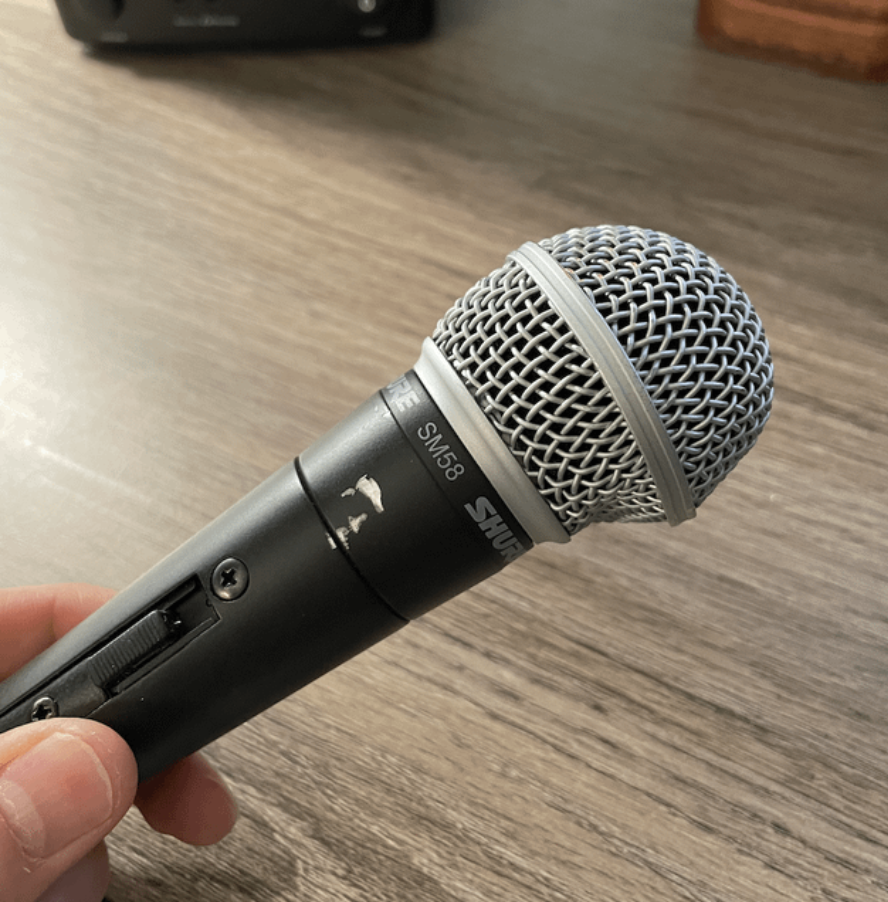
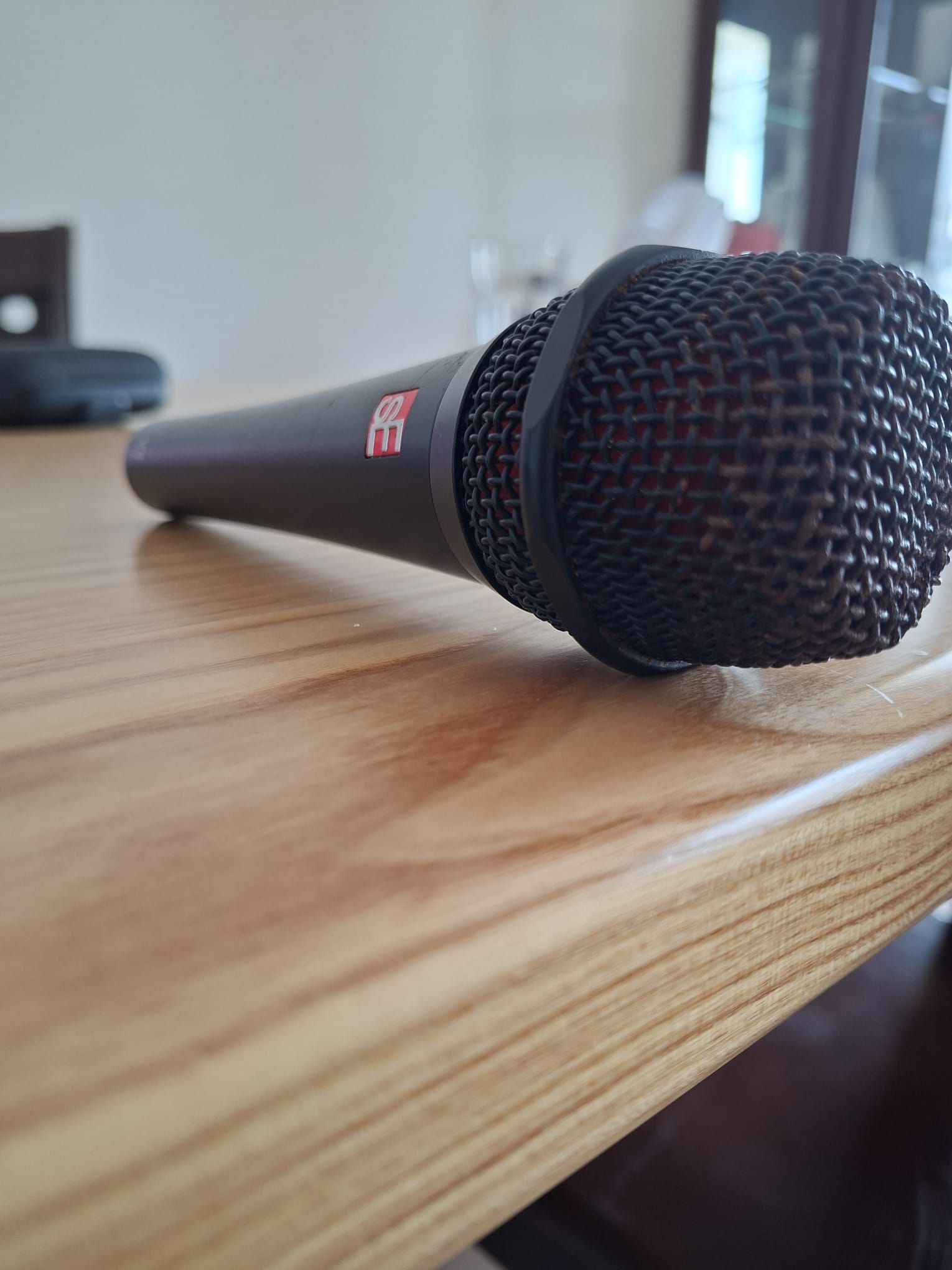
- The Grille: The SM58’s round grille is famous for denting safely to protect the capsule. However, put it on a flat amplifier top or table, and it will roll off. The sE V7 features a bevelled spring-steel mesh that prevents it from rolling away when set down, this has saved my mic more times than I can count!
- Windscreen: The V7 comes with an internal red windscreen installed, plus a spare black one in the box. This built-in pop filtering works exceptionally well for plosive control ("P" and "B" pops) without requiring an ugly external foam windscreen.
4. The Swag
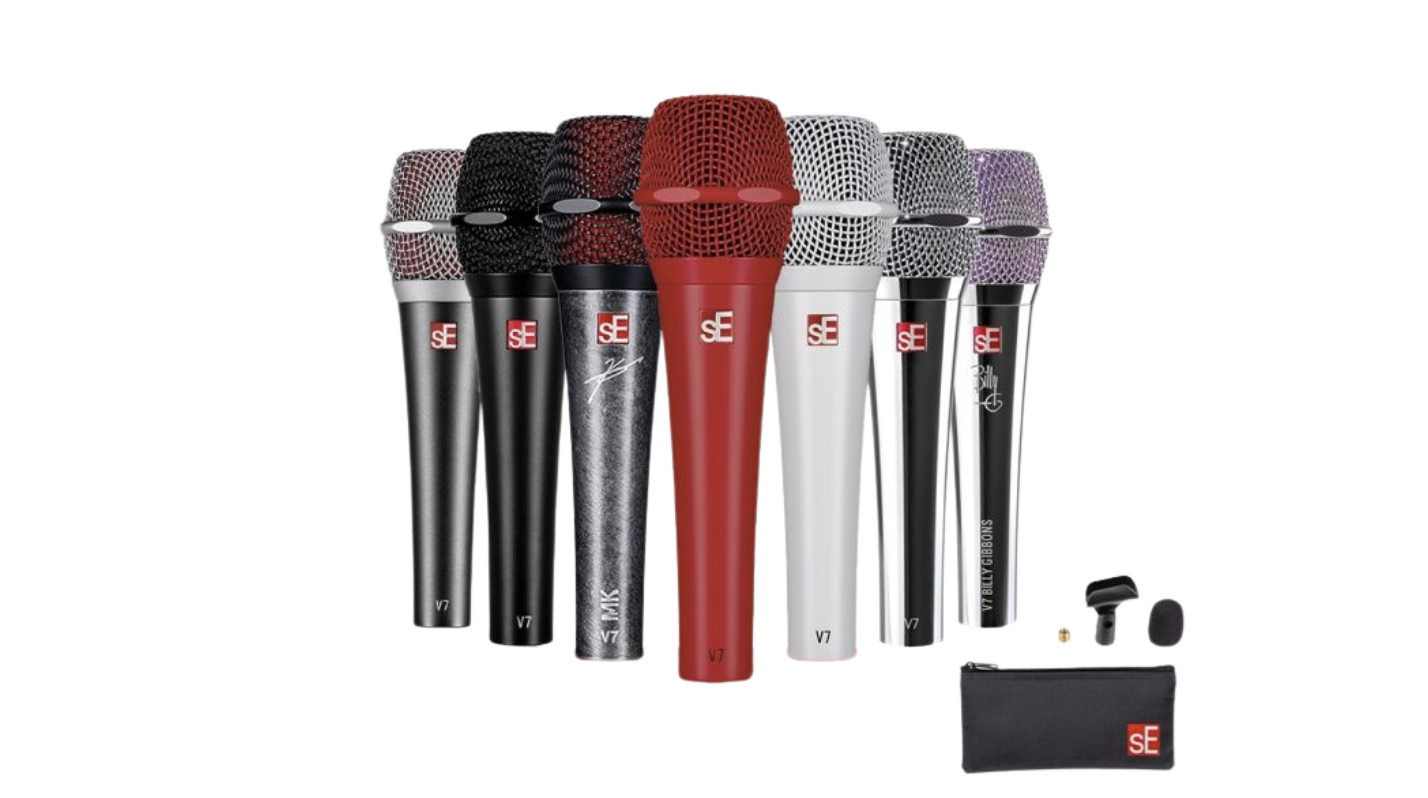
Let's be real, musicians like things that look nice, and the SM58 is kind of boring, just look at how many different colours you can get the V7 in!
Final Verdict: Which One Should You Buy?
Pick the Shure SM58 if:
- You're a female singer, especially in the mezzosoprano to soprano range.
- You're a more intimate performer who plays quieter shows.
- You're not very sound-tech savvy and want a foolproof workhorse that every house audio engineer can mix blindfolded.
- You prefer a warmer, mid-focused vocal tone with punchy low-end proximity.
Pick the sE Electronics V7 if:
- You're a male singer, especially in the baritone to bass range.
- You use In-Ear Monitors (IEMs) or dual monitor wedges set to the sides.
- You play in tight, loud rooms where you need to block out guitar/drum bleed from picking up in your vocal channel.
- You want modern, crisp, high-end clarity right out of the box without fighting the venue's EQ.
Today, the sE V7 is the clear winner for me. I gigged the SM58 for years and to be honest, I came to despise what it did to my voice. Nowadays I can't get enough of the sound the sE V7 delivers. But that applies to me and my voice type. If you're still on your search for a new mic, here's another article I wrote about this topic
 Adam Khan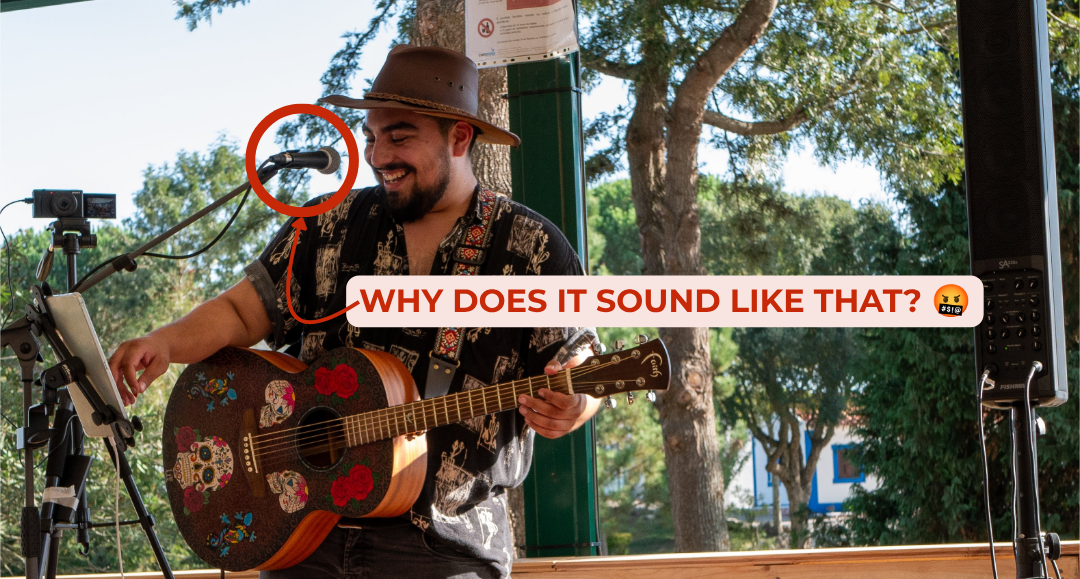
Don't forget to sign up and receive access to all the members area downloads!